
Where play
meets purpose.
Building tomorrow's leaders through social emotional learning. At The Recreation Academy, every kid is given a voice — through no-pressure group discussions after every activity, we help kids develop a growth mindset and discover what they're truly capable of.
What makes a Cadet?
Every participant becomes a Cadet. It's not just a title — it's a commitment to growth, respect, and rising to challenges.
A Commitment to Growth
Cadets don't just play games — they learn from every experience. Every activity is an opportunity to discover something new about themselves.
Rising to Challenges
We don't rescue kids from struggle. When someone gets frustrated or teams clash, that's our classroom. We guide them through it, teaching real skills for real situations.
Respect for Others
We model respect, and kids mirror it. When we listen to their ideas and use them, they become more invested. Respect flows both ways.
Supporting Teammates
Kids who don't just follow rules — they understand why they matter. They don't just participate — they contribute. They don't just play — they grow.
A Growth Mindset.
The Growth Mindset is the belief that abilities can be developed through effort and learning — the opposite of "you either have it or you don't." We believe in the power of "yet." When a child says "I can't do this," we add "yet" to the end. This simple shift changes everything.
A shy kid speaks up once → more likely to do it again.
A frustrated player takes a breath → discovers they can handle bigger setbacks.
A team talks through issues → kids take strategies into school and friendships.
Growth Mindset = Perseverance · Grit · Resilience
Our proven method.
Every session follows a structured approach that turns casual play into meaningful learning: Frontload → Experience → Debrief → Repeat.
Set Clear Expectations
Every session starts with clarity. Kids know what's expected because confusion kills confidence. When everyone understands the game, they can focus on playing it well.
Identify Teachable Moments
We listen before we lead. Kids have great ideas, and when we use them, they're more invested in the outcome. We embrace opportunities to model empathy and reinforce values.
Learn from Challenges
Here's what makes us different: we don't rescue kids from struggle. When someone gets frustrated or teams clash, that's our classroom. We guide them through it, teaching life skills for real situations.
Get Participant Feedback
After each activity, we pause and reflect. 'What went well?' 'What could we improve?' 'How did we show up for each other?' This turns fun into fuel for real development.
Understanding SEL.
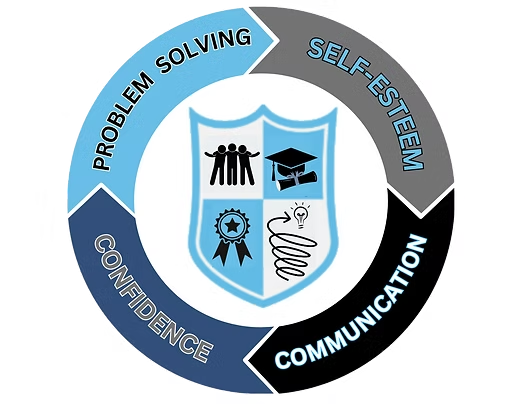
Social-Emotional Learning is the foundation of every Cadet's journey — the four core competencies we build into every activity.
Social Awareness
Recognize and name your own emotions. Pick up on non-verbal cues. Understand different perspectives. Appreciate diversity.
Real example: "I notice when my teammate looks frustrated, and I remember how I felt when I was struggling too."
Builds the ability to make and keep real friendships.
Relationship Skills
Express needs clearly. Collaborate and share leadership. Work through disagreements constructively. Know when and how to ask for support.
Real example: "Instead of walking away mad, I told my partner what I needed to feel included."
Builds the foundation for becoming a better leader.
Self-Management
Manage big feelings without explosive reactions. Think before acting. Work toward goals when it's difficult. Build coping strategies for pressure.
Real example: "When I get angry during the game, I take three deep breaths before I speak."
Develops routines, goals, and grit that stick.
Decision Making
Break down challenges into steps. Understand how choices affect others. Make choices based on values, not just convenience. Evaluate before acting.
Real example: "I thought about how my choice would affect my whole team before I decided."
Creates upward spirals — as kids gain confidence, they push themselves to do even more.
Why SEL matters for ages 5–14.
We tailor our approach to match where kids are developmentally.
Basic Emotions & Rules
- Basic emotion recognition and naming
- Simple self-regulation (stop, breathe, think)
- Following group rules and taking turns
- Beginning empathy ('How do you think they feel?')
Peer Collaboration & Communication
- Working in teams with assigned roles
- Understanding others' perspectives
- Communicating needs and boundaries clearly
- Basic conflict-resolution skills
Leadership & Complex Problems
- Leading and mentoring younger participants
- Complex problem-solving and goal setting
- Advanced empathy and perspective-taking
- Making ethical decisions under pressure
More than just supervision.
When you drop your child off at a Rec Academy program, you're not just getting safe supervision. You're getting a dynamic, trained facilitator whose mission is to help your child grow through movement, connection, and play.
Got questions? We've got answers.
Don't see your question? Email info@therecreationacademy.com.